One senior engineer owns your platform, from schema to deploy.
You brief the lead architect, not an account manager. The first call ends with a database schema, an API contract and a fixed milestone schedule in writing, before you are asked for a deposit.
- 13 years in production systems
- Reply within 24 hours
- No agency retainer
- Engagement
- Direct, one architect
- Spec delivery
- 24 hours, written
- Billing
- Fixed price per milestone
- Handover
- Repository, keys, runbook

- 100 Lighthouse mobile
- 41 ms TTFB, p50
- 13+ Years engineering
- 100% Code ownership
Built on the stack you can hire for tomorrow
- Next.js
- TypeScript
- Python / FastAPI
- PostgreSQL
- Redis
- Docker
- Tailwind CSS
- Cloudflare
Agencies sell you a team. You need the person who designs the database.
Most custom software is quoted by a seller, specified by a manager and written by someone who never spoke to you. That gap is where deadlines and budgets go. One direct line removes it.
Every technical question travels through a person who cannot answer it, then returns days later, already stale.
You message the person holding the schema. Answers land in the same thread the same day, with the code attached.
Decisions are made to fit the delivery template, not your traffic profile or the shape of your data model.
Schema, indexes and cache boundaries are argued against your real query volume before a screen is built.
Staging appears at the agreed demo dates, rebuilt from a branch you are never given access to.
Every working day ends with a URL you can click, on the milestone you are paying for.
Sales, account management and project coordination are billed into the same engineering rate you sign.
One senior rate, fixed per milestone. Added scope is quoted in writing before it is built.
The senior who pitched you is booked elsewhere. Your build lands with whoever is free, undocumented at handover.
One owner writes, reviews and merges. Full commit history, keys and runbook transfer with the repository.
Senior rate × 3.0 coordination tax
One senior rate, zero coordination tax

Written architecture in 24 hours.Working staging on day three.Your repository, your keys, your platform, at the end.
Three things I build better than a generalist team
Each tier below is a fixed engagement shape with its own deliverables. If your project does not fit one, the specification step will say so before you pay anything.
-
Product build
High speed web applications and SaaS MVPs
A complete product surface: tenant model, authentication, billing hooks and a server rendered front end. Built so the first hundred users do not require a rewrite for the first thousand.
- Normalised data models with migration history from commit one
- Server side rendering and route level caching for sub second navigation
- Session auth with role based access control and audit logging
- Automated test suite that gates every deploy
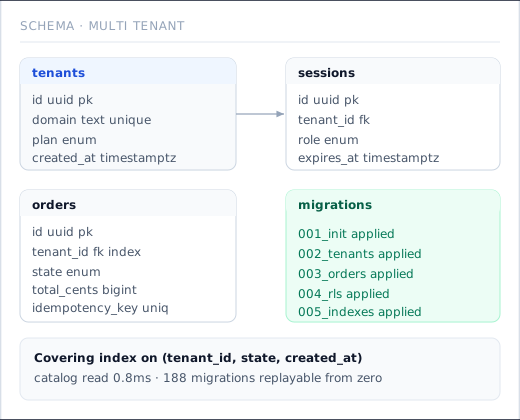
Schema first -
Commerce
Custom ecommerce and checkout engines
Catalogue, cart and payment flow written as one system instead of glued plugins. The checkout survives retries, duplicate webhooks and abandoned carts without double charging anyone.
- Catalog queries under 60 ms across a 20,000 item inventory
- QRIS, Midtrans and Stripe in one payment abstraction with idempotent callbacks
- Stock reservation that survives concurrent checkout attempts
- Receipt generation and order state machine with replayable events
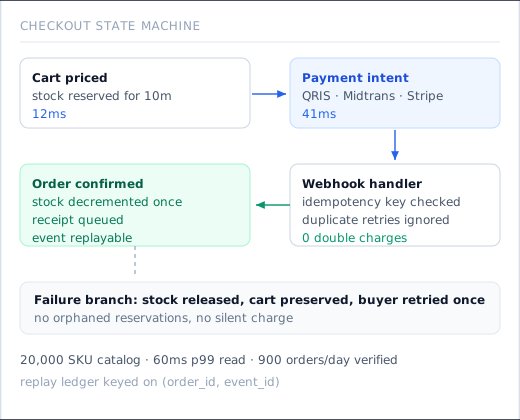
Idempotent by design -
Rescue
Platform rearchitecture and performance overhauls
You have a system that works and a bill that keeps climbing. I measure first, then change the two or three things that actually cause the latency, rather than rewriting everything to look busy.
- Query plan audit with index changes measured before and after
- Cache boundaries placed at the layer that removes the most work
- Lighthouse 100 on mobile with a documented performance budget
- Incremental migration path, no big bang cutover weekend
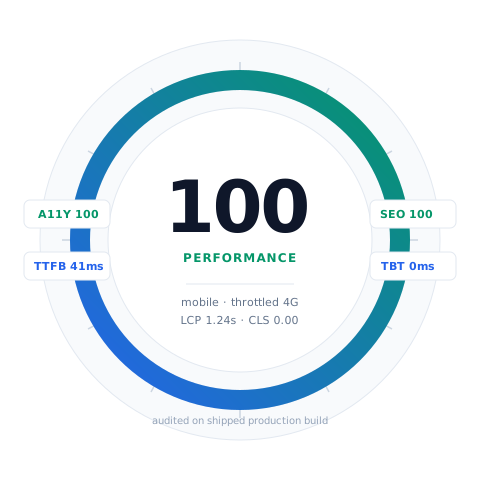
Measured after, not claimed


Every engagement starts with the diagram
Nothing is built until the request path is drawn and the latency budget is written down. This is the reference topology I start from, adapted to your traffic and your team.
- Edge handoff
- 34.2 msCloudflare to origin, cached HTML
- Service response
- 41 msFastAPI p50, read path
- Catalogue read
- 12 msPostgreSQL with a covering index
- Availability
- 99.98%Rolling 90 days

Three milestones, each one clickable
No phase ends with a slide deck. Each milestone ends with something you can open in a browser or read in a repository.
-
01
Spec and architecture lock
Delivered in 24hOne call, then a written specification. The data model, the API contract and the milestone dates are agreed before any code exists.
- Entity diagram and table definitions
- Endpoint list with request and response shapes
- Fixed price per milestone
-
02
Sprint staging and live previews
Same day mergeEach milestone closes with a deployed environment. You review the running product, not a screenshot, and comments land in the same repository.
- Staging URL after every merged milestone
- Weekly screen share plus async notes
- Seeded demo data for realistic review
-
03
Production hardening and full handover
Full ownership transferLoad test, index review and a restore drill on the real backup. Then the repository, keys and runbook move to accounts you own.
- Backup restore rehearsed once, on purpose
- Deploy and rollback runbook
- 30 day defect warranty included

Build your scope spec in about 40 seconds
Select the shape of the work. The live summary assembles itself as you choose, and becomes the body of the reply I send you within 24 hours.
Spec request received
Your answers are in. I read every request myself and reply with the architecture outline, the milestone split and the open questions I still need answered.
—
The things clients ask before signing
Straight answers, including the parts that usually get buried in a proposal.
I do. Aditya Firmansyah designs the schema, writes the application and reviews every merge. There is no delivery team behind the contract, so a junior developer is never handed your build after signature.
Within 24 hours you get a written specification: entity diagram, table definitions, API contract, milestone list with dates, and a fixed price per milestone. It is yours to keep whether or not we proceed.
Fixed price per milestone, not hourly. A typical engagement bills the first milestone on start, the second at the staging review and the remainder at handover. Scope changes are priced in writing before any work begins.
Yes, in full. The repository transfers to your account with complete commit history, environment keys are issued to you, and the deployment runs on accounts you control. There is no licence fee and no vendor lock in.
I write a short change note describing the delta, the added hours and the revised milestone date. You approve or reject it before implementation. Nothing is billed without that written approval.
Next.js App Router and TypeScript on the front end, FastAPI with Pydantic on the service layer, PostgreSQL for transactional data, Redis for caching and queues, Docker for deployment, Caddy or Cloudflare at the edge. Any deviation is justified in the specification.
Yes. I run a three day audit first: dependency and security review, index and query analysis, then a written report of what blocks release. You can stop after the audit and keep the findings.
Every delivery includes a 30 day defect warranty at no extra cost, plus a runbook covering deploy, rollback and backup restore. Ongoing maintenance is optional and priced monthly, never bundled into the build.
If the first milestone misses, you keep the specification and pay nothing further.
The terms are short on purpose: fixed price per milestone, code in your account from day one, and no retainer to escape.
Prefer email? [email protected]
- 01 · Ownership
- 100% IP ownershipRepository, commit history and keys transfer at handover.
- 02 · Price
- Fixed milestone priceThe quoted number is the invoiced number, per milestone.
- 03 · Exit
- Zero vendor lock inStandard stack, standard containers, your hosting accounts.